

📅 Published: February 28, 2026
📅 Last Updated: February 2026
What Is a Commercial Construction Loan?
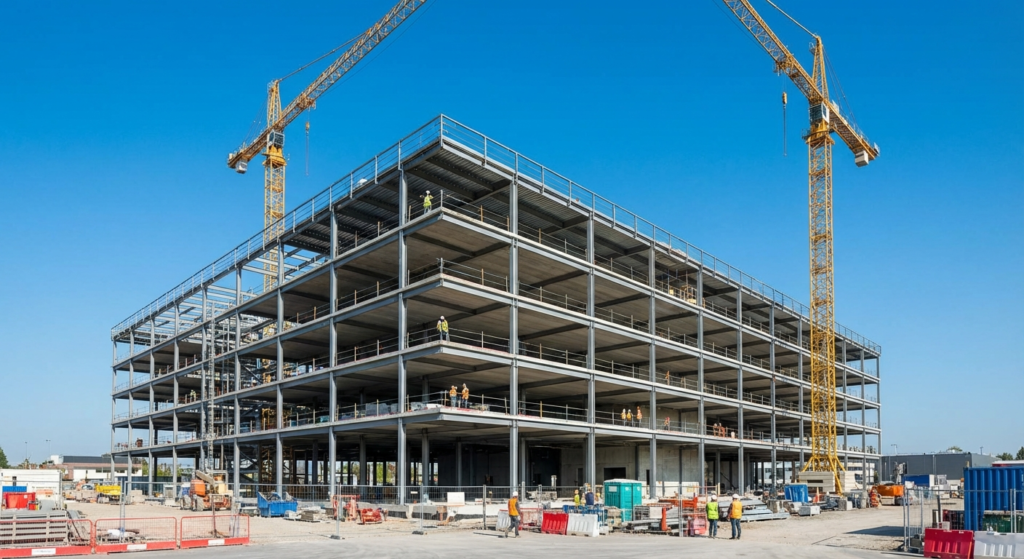
A commercial construction loan finances the ground-up development or major renovation of commercial real estate — office buildings, retail centers, warehouses, multifamily complexes, hotels, and mixed-use projects. Unlike a standard commercial mortgage where you’re buying a finished building, a construction loan funds the build itself.
Here’s the key distinction: you don’t receive the full loan amount at closing. Instead, the lender disburses funds in draws as construction milestones are completed. An inspector verifies the work, approves the draw, and the lender releases the next tranche. You only pay interest on the amount disbursed — not the total commitment.
In our experience brokering construction deals across Florida, the biggest challenge isn’t qualifying — it’s structuring the deal so the draw schedule, project timeline, and exit strategy align perfectly. Get that wrong, and you’ll run out of money before the building is finished.
Types of Commercial Construction Loans
Ground-Up Construction
You’re building from scratch on raw or improved land. Lenders underwrite the as-completed value and your construction budget. Most ground-up loans require:
- Detailed construction plans and specs
- A licensed general contractor with a track record
- Environmental clearance and permits
- A realistic project budget with contingency reserves
Construction-to-Permanent (C2P)
A single-close loan that converts from a construction facility to a permanent mortgage once the project is complete. This saves you a second round of closing costs and eliminates requalification risk.
When to use it: You plan to hold the asset long-term, and you want rate certainty from day one.
Renovation / Rehab Construction Loans
For substantial renovations — gut rehabs, adaptive reuse (converting an office building to apartments), or major value-add projects. The loan funds both the acquisition and the renovation.
Land + Construction Loans
Some lenders will finance the land purchase and the vertical construction in one package, though these are harder to find. Most require you to own the land free and clear (or with minimal existing debt) before they’ll fund the build.
How Construction Loan Draws Work
The draw process is what makes construction loans unique — and what trips up first-time developers.
Typical Draw Schedule
| Phase | % of Budget | What’s Funded |
|---|---|---|
| Pre-construction | 5–10% | Permits, architectural plans, site prep |
| Foundation | 15–20% | Excavation, foundation, underground utilities |
| Framing/Structure | 25–30% | Structural framing, roofing, exterior walls |
| MEP Rough-in | 15–20% | Mechanical, electrical, plumbing (rough) |
| Finishes | 15–20% | Interior finishes, fixtures, landscaping |
| Retainage Release | 5–10% | Held back until final inspection and CO |
How Draw Inspections Work
- Contractor completes a milestone and submits a draw request
- Lender sends a third-party inspector to verify the work
- Inspector confirms the work matches the approved budget line items
- Lender releases funds (usually within 5–10 business days)
- Retainage: Most lenders hold back 5–10% of each draw until the certificate of occupancy (CO) is issued
Pro tip: Build a 10–15% contingency into your construction budget. Unexpected costs — material price spikes, weather delays, change orders — are the norm, not the exception. Lenders won’t increase the loan amount mid-project.
Commercial Construction Loan Terms in 2026
| Parameter | Typical Range |
|---|---|
| Loan Amount | $500K – $50M+ |
| Loan-to-Cost (LTC) | 65% – 80% |
| Loan-to-Value (LTV) | 55% – 75% of as-completed value |
| Interest Rate | 8% – 13% (floating) |
| Term | 12 – 36 months (construction period + extension options) |
| Extension Options | 6–12 month extensions (usually with a fee) |
| Interest Reserve | Typically required (12–24 months of interest funded into the loan) |
| Origination Fee | 1.5% – 3% |
| Recourse | Usually full recourse; non-recourse available for $5M+ |
| Draw Inspections | $250–$500 per inspection |
| Contingency Required | 10–15% of hard costs |
What Do Lenders Look At?
Construction lending is riskier than permanent financing. The building doesn’t exist yet — there’s no cash flow, no tenants, and no proven value. Here’s what lenders evaluate:
1. Developer Experience
This is the #1 factor. Have you completed similar projects before? How many? Were they on time and on budget?
First-time developers: You’ll need to either partner with an experienced developer, hire a development manager, or work with lenders who specialize in sponsoring newer developers (they exist — we work with several).
2. General Contractor Qualifications
Lenders will underwrite your GC almost as heavily as they underwrite you. They want:
- A licensed, bonded, and insured contractor
- A track record of completing similar projects
- Financial statements showing the GC can weather delays
- A fixed-price contract (cost-plus contracts are harder to finance)
3. Project Feasibility
- Does the market support the proposed rents or sale prices?
- Is the location right for this product type?
- What’s the absorption timeline — how long to lease up or sell?
- What comparable projects have been built recently?
4. Budget and Pro Forma
- Is the construction budget realistic and line-item detailed?
- Does the pro forma show adequate returns to justify the risk?
- What’s the debt yield at stabilization?
- Is there a contingency reserve?
5. Exit Strategy
How does this loan get repaid? The three most common exits:
- Refinance into a permanent mortgage once stabilized
- Sell the completed asset
- Construction-to-perm conversion (if using a C2P structure)
Construction Loans for Specific Property Types
Multifamily / Apartment Construction
The most financeable construction category. Strong demand, predictable absorption, and multiple exit options. Lenders offer the most favorable terms (higher LTC, lower rates) for garden-style and mid-rise apartment projects in growing markets.
Retail / Mixed-Use Construction
Requires pre-leasing — most lenders want 40–60% of the space pre-leased before they’ll fund. Anchor tenant commitments (grocery store, pharmacy, national brand) strengthen the deal significantly.
Industrial / Warehouse Construction
Hot sector since 2020. Build-to-suit warehouses with a signed lease from a creditworthy tenant can achieve LTC up to 85%. Spec industrial (no tenant in place) is tougher but doable in strong logistics markets.
Hotel Construction
The most complex and highest-risk category. Lenders require extensive feasibility studies, franchise approval (for flagged properties), and experienced hospitality operators. Expect lower leverage (55–65% LTC) and higher rates.
Common Mistakes That Kill Construction Deals
- Underestimating the budget. Every experienced developer will tell you: it always costs more than you think. Build in contingency or don’t build at all.
- Choosing the wrong GC. The cheapest contractor isn’t the best contractor. Lenders will reject a deal if the GC doesn’t have the right experience and financials.
- No exit strategy. “I’ll figure it out when it’s done” isn’t a plan. Lenders need to see a clear, realistic path to repayment before they fund.
- Ignoring the draw process. Late draw requests, incomplete documentation, and sloppy budget tracking create costly delays. Treat draw management like a full-time job.
- Over-leveraging. Just because a lender will give you 80% LTC doesn’t mean you should take it. Higher leverage means higher risk — and if the project goes sideways, you’re personally on the hook.
How to Get a Construction Loan with No Experience
It’s harder, but not impossible. We’ve helped first-time developers secure construction financing by:
- Partnering with experienced developers who serve as co-sponsors on the deal
- Hiring a development consultant or owner’s rep with a strong track record
- Starting small — a duplex or small mixed-use project before attempting a 100-unit apartment complex
- Bringing more equity — if you can’t bring experience, bring cash. Higher equity contributions reduce lender risk.
- Working with brokers (like us) who know which lenders are open to newer developers and how to package the deal to address experience gaps
FAQ
What is the minimum down payment for a commercial construction loan?
Most commercial construction loans require 20–35% equity (the inverse of 65–80% LTC). Your equity can come from cash, land value, or a combination. If you own the land free and clear, its appraised value counts toward your equity contribution.
How long does it take to close a commercial construction loan?
Typically 45–90 days from application to closing. Construction loans require more due diligence than standard commercial mortgages — budget review, GC vetting, environmental reports, appraisals with as-completed values, and permit verification all take time.
Can I get a construction loan for commercial property with bad credit?
Yes, but with limitations. Private and hard money lenders will fund construction deals for borrowers with credit scores as low as 550, but expect higher rates (11–14%), lower leverage (60–70% LTC), and full recourse. A strong project, experienced GC, and substantial equity can offset credit concerns.
What happens if my construction project goes over budget?
The borrower is responsible for cost overruns. Lenders will not increase the loan amount mid-project in most cases. This is why contingency reserves (10–15% of hard costs) are critical. If you exhaust your contingency, you’ll need to bring additional cash or find mezzanine financing to complete the project.
What’s the difference between a construction loan and a bridge loan?
A bridge loan finances the acquisition of an existing building, typically for repositioning or stabilization. A construction loan finances the actual building process. Bridge loans disburse in full at closing; construction loans disburse in draws as work is completed. Construction loans generally have longer terms (18–36 months) and require more documentation.
Do I need a general contractor for a commercial construction loan?
Yes. Nearly all commercial construction lenders require a licensed, bonded, and insured general contractor with a track record of similar projects. Owner-builder arrangements are rarely accepted for commercial construction loans. The GC must provide a fixed-price or guaranteed-maximum-price (GMP) contract.
Need construction financing? Whether it’s your first ground-up project or your twentieth, we’ll connect you with the right lender for your deal. Get in touch →
About the Author

Brandon Brown is the founder of Anchor Commercial Capital, which exists to protect momentum when timing matters most. Based in Boca Raton, Florida, Brandon is a seasoned investor and technologist specializing in the intersection of commercial lending and data-driven deal execution. His professional background includes founding Rapid Surplus Refund and co-founding Lien Capital, experiences that inform his pragmatic approach to complex debt structures. Brandon is dedicated to providing sponsors with the clarity and execution certainty required in today’s volatile markets. Connect with Brandon on LinkedIn to discuss your next commercial deal.